Porcelain Restorations & Smile Design with Dr. Vik
When colour, shape and proportion all need lifting together, porcelain gives me the most control of any material — designed digitally, crafted by a master ceramist, and always as minimal-prep as your case allows.
✓ Free consultations · ✓ 0% finance · ✓ Trial smile before you commit
Porcelain done properly doesn't look like porcelain. It looks like the smile you were meant to have.
— The standard I hold every veneer case to
What Is Porcelain?
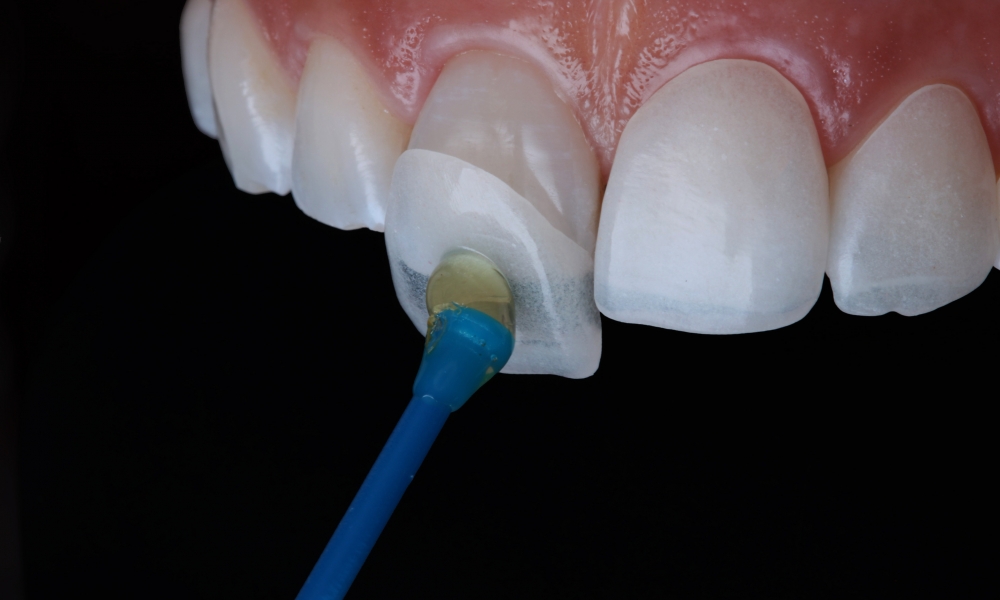
Porcelain restorations change shape, cover deep discolouration, close spaces and refresh worn edges — with a finish nothing else matches.
I reach for porcelain when refinement is needed across multiple dimensions at once:
Colour that whitening alone can't fully improve
Shape, edge position and tooth proportion
Small gaps, chips, wear and asymmetry
A complete, coordinated smile redesign
I'll always tell you honestly if porcelain isn't the right first move:
Healthy teeth and gums, and a stable bite
Alignment corrected first where needed — often with Invisalign
Minor edge issues that bonding could solve more conservatively
A plan led by need, never by trend
Why Porcelain
When properly planned, porcelain offers precision and consistency that's hard to achieve any other way.
For teeth that are stained, patchy or resistant to whitening — porcelain delivers a uniform, natural shade that holds for years.
Softens uneven edges, improves width-to-length proportion and creates a harmonious smile line designed around your face.
When several front teeth need bringing into visual balance at once, porcelain lets me control every tooth to the same standard.
Real Cases · Real Patients
Designed by me, crafted with my ceramist, fitted with obsessive attention to detail. Drag through.
My Process
Good planning is what separates a natural result from an artificial one.
We discuss what you want to change, I assess suitability, and we decide together whether porcelain is the right path — or whether another option should come first.
Photos, scans and planning define tooth shape and proportion. You see a trial smile — a physical preview on your own teeth — before anything is committed.
Some cases need minimal preparation to create space and fit. My goal is always to stay as conservative as your case allows — sometimes no drilling at all.
The final porcelain is bonded, checked for bite and aesthetics, and reviewed until it feels balanced, comfortable and completely yours.
“I recently had the pleasure of being treated by Dr. Vikas Bajaj — an exceptional experience. His professionalism and expertise were evident from the moment I stepped in.”
Verified Patient — Doctify
Read more of my reviews →Questions? Answered.
No — but they require careful planning. Some cases need minimal preparation; others need more reshaping depending on the starting position and the goal.
The key is using porcelain only when it's genuinely the right treatment. Placed well and for the right reasons, in the right case, well-planned veneers can help support the tooth structure; the effect on each tooth is assessed individually, and some enamel preparation is usually required.
Typically 10 to 20 years or more with proper care. Longevity depends on bite forces, habits, maintenance and the health of the supporting teeth and gums.
They're not lifetime restorations, but well-made porcelain holds its colour, shape and surface quality far longer than composite alternatives.
They do different jobs. Porcelain offers more control over shape, translucency and colour stability — better for larger changes and durability. Bonding is more conservative and often right for smaller refinements.
I offer both, so my recommendation is based purely on what your case needs — not on what I happen to sell.
Porcelain is far more stain-resistant than natural enamel or composite. The glazed surface repels tea, coffee and red wine.
The margins where porcelain meets tooth, and your surrounding natural teeth, still need normal care — good hygiene keeps the whole smile consistent.
Most cases take two to three appointments: planning and preparation first, then fitting the final restorations. A trial smile stage may add a visit — and it's worth it.
Between visits you wear well-made temporaries while the ceramist crafts the final porcelain to our agreed design.
Sometimes, yes. Minimal-prep and no-prep veneers work when teeth are already well-positioned and the change is mostly additive — adding length or closing small gaps.
Most cases benefit from some preparation to avoid a bulky result. Exactly how much is always discussed and agreed at the planning stage.